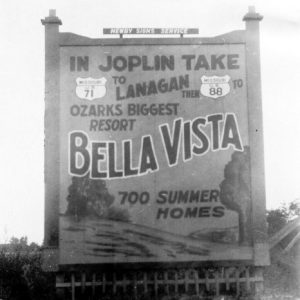
 Bella Vista
 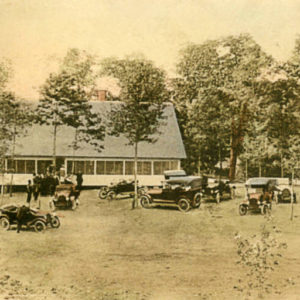 Bella Vista Dining Lodge
 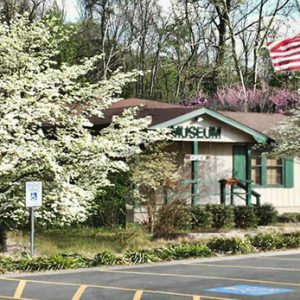 Bella Vista Historical Museum
 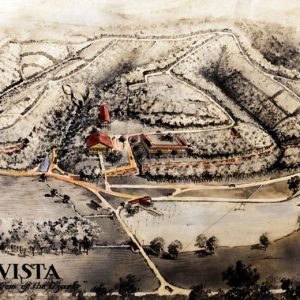 Bella Vista Plan
 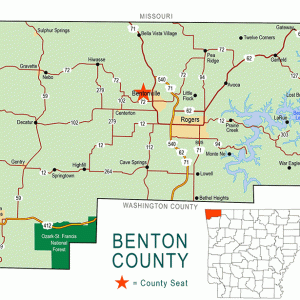 Benton County Map
 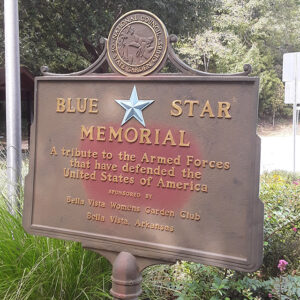 Blue Star Plaque
 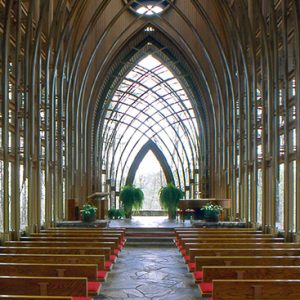 Cooper Chapel
 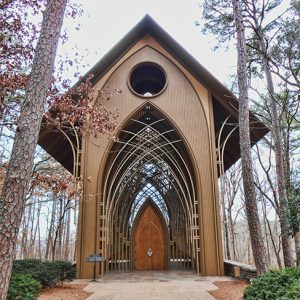 Cooper Chapel
 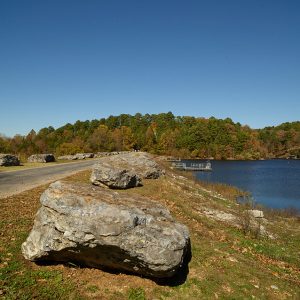 Lake Norwood
 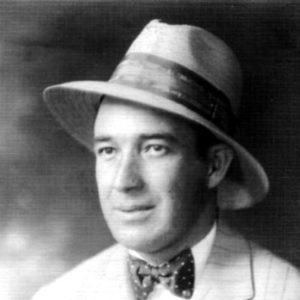 Clarence Linebarger
 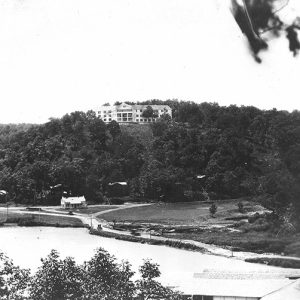 Sunset Hotel
 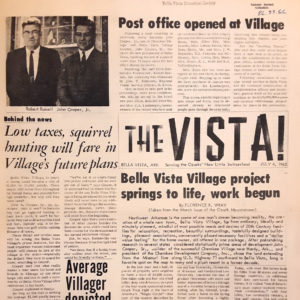 Weekly Vista First Edition
  Wonderland Cave
  Wonderland Cave
  Wonderland Cave Entrance
  Wonderland Cave Visitors
501-918-3025
calsfoundation@cals.org
calsfoundation@cals.org
| Latitude and Longitude: | 36°28’53″N 094°16’24″W |
| Elevation: | 1,237 feet |
| Area: | 45.31 square miles (2020 Census) |
| Population: | 30,104 (2020 Census) |
| Incorporation Date: | December 7, 2006 |
Historical Population as per the U.S. Census:
|
1810 |
1820 |
1830 |
1840 |
1850 |
1860 |
1870 |
1880 |
1890 |
1900 |
|
– |
– |
– |
– |
– |
– |
– |
– |
– |
– |
|
1910 |
1920 |
1930 |
1940 |
1950 |
1960 |
1970 |
1980 |
1990 |
2000 |
|
– |
– |
– |
– |
– |
– |
– |
2,589 |
9,083 |
16,582 |
|
2010 |
2020 |
|
|
|
|
|
|
|
|
|
26,461 |
30,104 |
|
|
|
|
|
|
|
|
Bella Vista in Benton County was originally planned as a summer recreation resort. Half a century later, the resort began transforming into a graduated retirement community. In 2006, citizens voted to incorporate, setting the stage for the next transformation for Bella Vista.
Louisiana Purchase through Early Statehood
Bella Vista sits in the Ozark Plateau geographical region where many native groups, including the Osage, Caddo, and Quapaw, lived. The 1808 and 1809 treaties between the United States and the Great and Little Osage in Missouri and the Osage residing on the Arkansas River transferred 30 million acres of Native American land titles to the government. A portion of this land, once the heartland of the Osage, eventually became Bella Vista.
Early Twentieth Century
William S. Baker, a Benton County Presbyterian minister, and his wife, Mary, decided in 1915 to develop a summer recreation area in Benton County. Damming Sugar Creek created a large lake suitable for swimming. The Bakers’ plans called for adjacent tennis courts, golf links, and nearly 400 lots selling at $100 each. A contest was used to select the resort’s name, with the winning entry being Bella Vista (“beautiful view”). Business was not lucrative, however, and by 1916, the resort was offered for sale.
Samuel and Mary Linebarger and their three sons moved in 1900 to Bentonville (Benton County) for a change in climate following Mary’s diagnosis with tuberculosis. After she died two years later, the family left Arkansas. However, in 1916, the Linebarger Brothers Realty Company, founded by Samuel’s three sons, returned to purchase Bella Vista along with adjoining acreage, seeking a new investment.
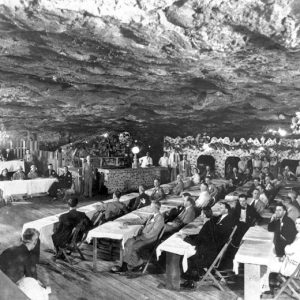
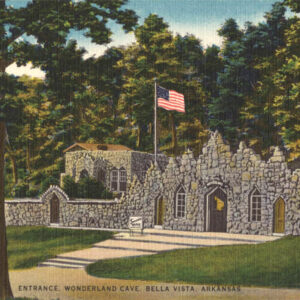
Initial expansion plans called for a pavilion suitable for dancing, a thirty-room lodge, and a dining hall. A nine-hole golf course was added in 1921, a large swimming pool in 1924, and the sixty-five-room Sunset Hotel in 1929. In 1930, the brothers developed a cave into a nightclub, calling it Wonderland.
The resort retained the Bella Vista name and opened from Memorial Day to Labor Day, renting rooms by the day or the week, selling lots, and building cottages. Bella Vista amenities included swimming, golf, tennis, fishing, camping, horse rides, rowing, games, and dances with orchestral music. The Linebargers catered to wealthy, urban families who could spend the entire summer on vacation.
World War II through the Faubus Era
Under the leadership of Clarence A. Linebarger, the youngest Linebarger brother, summer business progressively improved. However, the Great Depression, World War II, and changing vacation concepts—with automobiles and highways allowing people to venture to new and distant places—resulted in the resort’s decline.
Elzy Lloyd Keith, who operated the Lake Keith Resort in Cave Springs (Benton County), purchased Bella Vista in 1952, billing it as “Bella Vista the Family Resort, the Beauty Spot of the Ozarks.” Keith transitioned Bella Vista into a family resort, substituting roller-skating for dancing, and added a restaurant, grocery, and motel, along with the state’s first mini-golf course. Keith closed the Sunset Hotel after one year, giving it to a Baptist minister to start a school. Within five years, the school also closed.
Modern Era
In 1965, John A. Cooper Sr., who had developed the Cherokee Village (Sharp County) retirement community, began selling home sites he had purchased in Bella Vista, promoting his idea of a “graduated retirement,” in which people bought lots that would be paid in full by the time they were ready to retire. Owners could also purchase “vacation-retirement homes,” building homes for use as vacation sites with the intent to retire in those homes. Whether present or absent, Bella Vista lot ownership entitled one to all Bella Vista amenities. In thirty-five years, Cooper sold 37,060 home sites. By the end of 2006, there were roughly 38,000 home sites, of which 12,600 lots were developed.
The Highlands section with Loch Lomand opened in 1979. Within the first year, 1,370 of the 2,700 home sites were sold. Fiscal year 1981 ended with $30 million in home site sales, and fiscal year 1983 saw $36 million. In 1987, Bentonville’s state senator Joe Yates’s study showed that 16.5 percent of all the taxes received by the Benton County government and forty-five percent of tax revenue for the Bentonville School District came from Bella Vista. In 1992, Bank of Bentonville deposits reflected that thirty-four percent came from residents of Bella Vista. The 1981 Bella Vista population of 4,262 had grown to 9,628 by 1990 and was estimated at 10,800 by 1992. The nationwide initial downturn in real estate in the 1990s did not dampen Bella Vista’s growth.
The Property Owners Association (POA)—formed in 1965 as the Bella Vista Country Club, renamed POA on April 6, 1973, and led by a nine-member board of directors elected by all property owners—managed all the affairs of the village. With close to sixty percent of assessment revenue from undeveloped lots, nonresidents have the largest block of votes.
Incorporation emerged as an issue in 1977, continuing through 1986. Whenever financial struggles faced the POA, so did the question of incorporation. Informal surveys at POA meetings showed a majority never supported the change. Between 1986 and 1990, the incorporation debate died down. However, in 1991, the Committee for Incorporation formed in hopes of winning over residents to incorporation and getting the needed registered voters’ signatures on an incorporation petition. Their petition effort fell short. Generally, people wanted to keep the status quo.
In 2005, state representative Shirley Borhauser of Bella Vista sponsored a bill—approved by the legislature as Act 1237—changing the requirement for incorporation petition signatures from fifty percent to twenty-five percent of registered voters; the 1991 effort had obtained thirty-one percent. The law was proposed with Bella Vista in mind. By 2006, Bella Vista was the largest of the twenty-two unincorporated communities in Arkansas. On November 7, 2006, the citizens of Bella Vista voted by a two-to-one margin for incorporation.
In unison with the incorporation vote, town government elections were held for eight positions (mayor, recorder/treasurer, city attorney, and five aldermen). Census Bureau statistics show that the percentage of residents age sixty-five and older was 49.1 percent at the 1990 census but dropped in 2000 to 21.4 percent; however, it rose again to 31.5% by the 2010 census. Children of school age in Bella Vista accounted for 19.1 percent of Bentonville School District students in 2006. In 2006, the Bentonville School District began construction of an elementary school on the east side of Bella Vista to accommodate 750 students. Bella Vista has changed from a retirement community to a bedroom community primarily for the Walmart Home Office in nearby Bentonville and Walmart vendor companies in the Bentonville/Rogers (Benton County) area.
A 2008 flood damaged the dam on Sugar Creek creating Lake Bella Vista, but it was soon rebuilt and improved. Flooding in 2011, 2013, and 2015 topped the dam. In April 2021, heavy rains washed out a section of the dam, forcing local leaders to decide whether to rebuild or remove the dam.
In 2023, local residents started a petition to try to establish a school district in the city. Most students attend school in Bentonville.
The Bella Vista Historical Museum, established in 1985, serves the local community. Historic properties include the Bella Vista Water Tank and the Mildred B. Cooper Memorial Chapel. The community is served by the Weekly Vista newspaper.
For additional information:
Bella Vista Historical Museum. Bella Vista, Arkansas.
Beautiful Bella Vista. http://beautifulbellavista.com/ (accessed April 13, 2022).
Fite, Gilbert C. From Vision to Reality: A History of Bella Vista Village, 1915–1993. Rogers, AR: RoArk Printing, Inc., 1993.
Lucas, Xyta, and Dale Phillips. Bella Vista. Charleston, SC: Arcadia Publishing, 2021.
Parks, Michelle. “Resort with a View.” Arkansas Democrat-Gazette, July 25, 2006, p. 1E.
Phillips, George H., ed. The Bella Vista Story. Bella Vista, AR: Bella Vista Historical Society, 1980.
Shipley, Ellen Compton. “The Pleasures of Prosperity, Bella Vista, Arkansas, 1917–1929.” Arkansas Historical Quarterly 37 (Summer 1978): 99–129.
Talbot, Tish. “John A. Cooper, Sr.: A Vision of the Future.” Arkansas Times, March 1983, pp. 30–33, 36–40.
John Spurgeon
Bella Vista, Arkansas





Comments
No comments on this entry yet.