





501-918-3025
calsfoundation@cals.org
calsfoundation@cals.org
The attorney general, one of the state’s seven constitutional offices, is the state’s top law enforcement officer and consumer advocate.
The office of attorney general was not originally a constitutional office but rather was created by Act 1 of 1843, which designated the state’s attorney for its Fifth Judicial District as the attorney general. The first attorney general was Robert W. Johnson. The constitution of 1868 made the post elective, though it required only that the attorney general “perform such duties as are now, or may hereafter, be prescribed by law.” This was reaffirmed in the constitution of 1874. Act 131 of 1911 laid out four general responsibilities of the attorney general’s office: 1) to give opinions to state officers and agencies “upon any constitutional or other legal question that may concern the official action of said officers”; 2) to defend the interest of the state in federal court and representing all state officers, boards, and commissions in litigation involving the interests of the state; 3) to furnish any board or commission an opinion as to the validity of the title on any land they seek to purchase; and 4) to make a biennial report to the governor and the Arkansas General Assembly on all transactions of the attorney general’s office.
Among the divisions in the attorney general’s office are the Civil Department, which represents state agencies and officials named as defendants in lawsuits and serves as in-house counsel for such; Community Relations, which aids victims and offers education about issues of law and safety; the Criminal Department, which aims to uphold valid convictions and shape criminal legislation; the Medicaid Department, responsible for prosecuting Medicaid fraud; the Opinions Department, responsible for providing written legal opinions to state agencies; and the Public Protection Department, the consumer advocacy arm of the office.
Several attorneys general have been part of larger political machines. William Fosgate Kirby, for example, was handpicked by Governor Jeff Davis for the job and, while in office, worked fiercely to advance the governor’s antitrust policies. Bruce Bennett likewise embraced the segregationist policies of Governor Orval Faubus and authored a great deal of legislation designed specifically to harass civil rights groups; he later was implicated in several instances of fraud, having used his legal powers to help a company he had helped found dodge regulation.
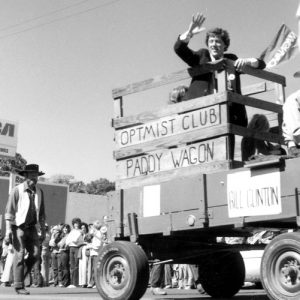
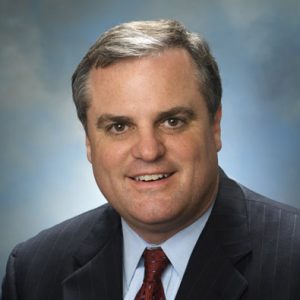
The post of attorney general has frequently been a stepping stone for higher office in Arkansas politics, especially in the late 1960s and 1970s, when the office was publicly involved in consumer affairs, especially utility rate increases. (Governor Dale Bumpers sponsored the creation of a consumer protection division within the office of the attorney general.) James P. Clarke, Jeff Davis, Carl E. Bailey, Bill Clinton, and Mike Beebe all went directly from attorney general to be elected as governor, while others, such as Simon P. Hughes and Jim Guy Tucker, had a background of service as attorney general before running for governor. Ray Thornton and Tucker served as attorneys general before being elected to the U.S. House of Representatives, Mark Pryor was elected to the U.S. Senate after one term as attorney general, and Kirby followed up his service with election to the Arkansas Supreme Court and, later, the U.S. Senate. Note: Attorneys general were appointed from 1843 to 1864. No party is listed for them in those years, or for others who were appointed to finish terms in 1865, 1866, 1915, 1934, 1962, 1973, 1977, 1990, 1991, and 2003.
| NAME | PARTY | BEGAN | ENDED |
| Robert W. Johnson | – | 1843 | 1848 |
| George C. Watkins | – | 1848 | 1851 |
| J. J. Clendenin | – | 1851 | 1856 |
| Thomas Johnson | – | 1856 | 1858 |
| J. L. Hollowell | – | 1858 | 1861 |
| P. Jordan | – | 1861 | 1862 |
| Sam W. Williams | – | 1862 | 1864 |
| Charles T. Jordan | Rep | 1864 | 1865 |
| R. S. Gantt | – | 1865 | 1866 |
| R. H. Deadman | – | 1866 | 1868 |
| J. R. Montgomery | Rep | 1868 | 1873 |
| T. D. W. Yonley | Rep (Min) | 1873 | 1874 |
| James L. Witherspoon | Dem | May 1874 | Nov 1874 |
| Simon P. Hughes | Dem | 1874 | 1876 |
| William F. Henderson | Dem | 1877 | 1881 |
| Charles B. Moore | Dem | 1881 | 1885 |
| Daniel W. Jones | Dem | 1885 | 1889 |
| William E. Atkinson | Dem | 1889 | 1893 |
| James P. Clarke | Dem | 1893 | 1895 |
| E. B. Kinsworthy | Dem | 1895 | 1899 |
| Jeff Davis | Dem | 1899 | 1901 |
| George W. Murphy | Dem | 1901 | 1905 |
| Robert L. Rogers | Dem | 1905 | 1907 |
| William F. Kirby | Dem | 1907 | 1909 |
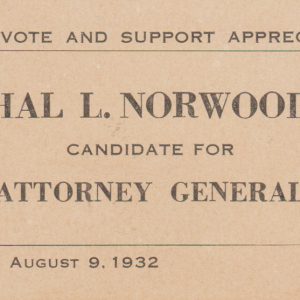
| Hal L. Norwood | Dem | 1909 | 1913 |
| William L. Moose | Dem | 1913 | 1915 |
| Wallace Davis | – | 1915 | 1917 |
| John D. Arbuckle | Dem | 1917 | 1921 |
| J. S. Utley | Dem | 1921 | 1925 |
| W. H. Applegate | Dem | 1925 | 1929 |
| Hal L. Norwood | Dem | 1929 | 1934 |
| Walter L. Pope | – | 1934 | 1935 |
| Carl E. Bailey | Dem | 1935 | 1937 |
| Jack Holt | Dem | 1937 | 1943 |
| Guy E. Williams | Dem | 1943 | 1949 |
| Ike Murry | Dem | 1949 | 1953 |
| Tom Gentry | Dem | 1953 | 1957 |
| Bruce Bennett | Dem | 1957 | 1961 |
| J. Frank Holt | Dem | 1961 | 1961 |
| Jack Holt Jr. | – | 1962 | 1963 |
| Bruce Bennett | Dem | 1963 | 1967 |
| Joe Purcell | Dem | 1967 | 1971 |
| Ray Thornton | Dem | 1971 | 1973 |
| Rodney Parham | – | 1973 | 1973 |
| Jim Guy Tucker | Dem | 1973 | 1977 |
| Bill Wilson | – | 1977 | 1977 |
| Bill Clinton | Dem | 1977 | 1979 |
| Steve Clark | Dem | 1979 | 1990 |
| Ron Fields | – | 1990 | 1990 |
| Mary Stallcup | – | 1991 | 1991 |
| Winston Bryant | Dem | 1991 | 1999 |
| Mark Pryor | Dem | 1999 | 2003 |
| Leon Johnson | – | 2003 | 2003 |
| Mike Beebe | Dem | 2003 | 2006 |
| Dustin McDaniel | Dem | 2007 | 2015 |
| Leslie Rutledge | Rep | 2015 | 2023 |
| Tim Griffin | Rep | 2023 |
For additional information:
Arkansas Attorney General. https://arkansasag.gov/ (accessed August 16, 2023).
Blair, Diane, and Jay Barth. Arkansas Politics and Government. 2nd ed. Lincoln: University of Nebraska Press, 2005.
Bowden, Bill. “AG Opens Fayetteville Office.” Arkansas Democrat-Gazette, February 12, 2026, pp. 1B, 2B. Online at https://www.arkansasonline.com/news/2026/feb/11/arkansas-attorney-general-opens-fayetteville/ (accessed February 12, 2026).
McFadin, Daniel. “AG’s Office Prepares for Move.” Arkansas Democrat-Gazette, April 14, 2025, pp. 1B, 2B. Online at https://www.arkansasonline.com/news/2025/apr/13/state-ags-office-ready-to-make-move-to-historic/ (accessed April 14, 2025).
Staff of the CALS Encyclopedia of Arkansas


Comments
No comments on this entry yet.