

501-918-3025
calsfoundation@cals.org
calsfoundation@cals.org
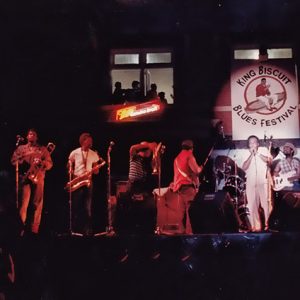
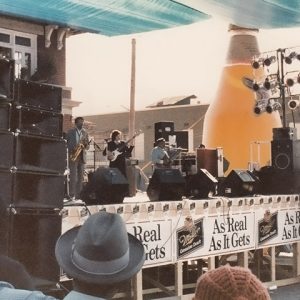
The first weekend in October, the Mississippi River town of Helena-West Helena (Phillips County), about seventy miles southwest of Memphis, Tennessee, becomes a thriving community of blues musicians and their fans, gathered to celebrate the King Biscuit Blues Festival.
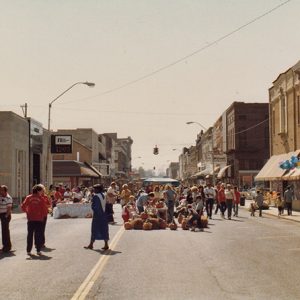
The festival grounds now lie along a levee, but during the early years, the festival was held on the back of a flatbed truck in front of an old train depot, which is now a museum and the site of the Delta Cultural Center on Cherry Street. Cherry Street, which parallels the Mississippi River, is a National Historic District and the historic commercial center of the town. What began in 1986 as a one-day event with a crowd of 500 has become a three-day event with more than 100,000 people attending. The festival draws blues enthusiasts from around the nation and around the world. Despite Helena-West Helena’s declining population, hotels and motels have few vacancies on festival weekend.
The festival now sprawls well beyond its initial 1986 boundaries. By 2013, there were six stages. Musicians are booked not only on the main stage but also on ones that include gospel choirs and other groups in addition to artists who perform more traditional Delta blues. One stage is called the Houston Stackhouse Stage in the morning and the Robert Junior Lockwood Stage in the afternoon, each named for a local blues legend. All along Cherry Street are vendors selling their blues-related crafts and food. The festival also hosts a barbecue competition.
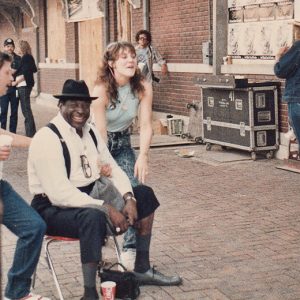
The event frequently attracts blues musicians who play on street corners and can be heard throughout the grounds. Scattered among the vendors are artists who manage to plug their amps into a shop’s outlet, allowing them to perform as small crowds gather and people toss coins into hats. Up and down the street, visitors can catch glimpses of well-known blues artists, and perhaps even a politician (Arkansas governor Mike Huckabee frequented the festival and even played bass guitar one year) or a mime troupe. Bicyclists compete in a morning race before the crowds become too large.
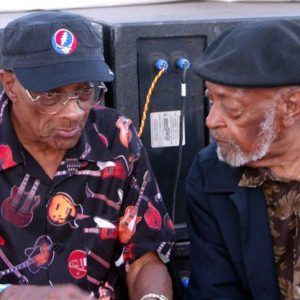
The festival’s first day (Thursday) culminates with the announcement of local blues awards given to performers who competed prior to the festival. The festival’s climax is on Saturday night, when a renowned guest artist performs. Longtime King Biscuit Time radio program host Sonny “Sunshine” Payne often hands out the awards to young musicians as well as legendary artists such as Pinetop Perkins, who was a regular, or Sam Carr, who appeared on the King Biscuit Time radio program in its early days. Others have included “T-Model” Ford, Frank Frost, Luther Allison, Big Jack Johnson, John Weston, Billy Lee Riley, Anson Funderburgh, Di Anne Price, and Vickie White. The festival’s climax is on Saturday night, when a renowned guest artist performs.
The festival took its name from the King Biscuit Time radio program until 2005, when the festival’s organizer, the Sonny Boy Blues Society, announced that the name would change to the Arkansas Blues and Heritage Festival because the New York firm that owned the rights to the King Biscuit name wanted too much money for its use. However, in 2010, the management of the festival succeeded in regaining the use of the name.
In the early twenty-first century, the festival began including panel discussions on the importance of the blues and the role radio has played in it. In 2001, the Delta Cultural Center hosted such a panel, which was scheduled just before Payne’s program. At the cultural center, visitors may view a film loop that includes parts of past festivals while hearing Payne interviewing a guest or playing a song on his program. His radio booth at the Delta Cultural Center is partitioned off from passersby, but the live show is easily accessible to guests.
In addition to storms and occasional equipment failure, each year brings a surprise or two. In 1998, Huckabee, a Baptist minister, married a couple on the main stage a year after they had met at the previous year’s festival. During another festival, a strong wind knocked over a huge inflated Budweiser can next to the main stage, which organizers repaired as thousands watched. In 1996, Luther Allison continued playing as he left the main stage and meandered up and down the levee, wirelessly amplifying his guitar licks while photographers snapped pictures and the crowd went wild.
The festival attracts people from all walks of life. Despite changes in the music and the occasional non-traditional sound, as Payne once said, “Sooner or later they all come back to it.”
For additional information:
Fuhr, LeDawn Lee. “Delta Sources and Resources: King Biscuit Blues Festival.” Arkansas Review: A Journal of Delta Studies 49 (August 2018): 134–136.
King Biscuit Blues Festival. http://www.kingbiscuitfestival.com/ (accessed July 11, 2023).
Koon, David. “Fighting over a ‘Biscuit.’” Arkansas Times, February 23, 2006.
Rotenstein, David S. “The Helena Blues: Cultural Tourism and African-American Folk Music.” Southern Folklore 49 (Summer 1992): 133–146.
Webb, Robert Fry. “We Are the Blues: Individual and Communal Performances of the King Biscuit Tradition.” PhD diss., Florida State University, 2010.
Richard Allen Burns
Arkansas State University


Comments
No comments on this entry yet.