






501-918-3025
calsfoundation@cals.org
calsfoundation@cals.org
| Region: | Northwest |
|---|---|
| County Seat: | Waldron |
| Established: | November 5, 1833 |
| Parent Counties: | Crawford, Pope |
| Population: | 9,836 (2020 Census) |
| Area: | 892.85 square miles (2020 Census) |
| Historical Population as per the U.S. Census: | |||||||||
|
1810 |
1820 |
1830 |
1840 |
1850 |
1860 |
1870 |
1880 |
1890 |
1900 |
|---|---|---|---|---|---|---|---|---|---|
|
– |
– |
– |
1,694 |
3,083 |
5,145 |
7,483 |
9,174 |
12,635 |
13,183 |
|
1910 |
1920 |
1930 |
1940 |
1950 |
1960 |
1970 |
1980 |
1990 |
2000 |
|
14,302 |
13,232 |
11,803 |
13,300 |
10,057 |
7,297 |
8,207 |
9,685 |
10,205 |
10,996 |
|
2010 |
2020 |
|
|
|
|
|
|
|
|
|
11,233 |
9,836 |
|
|
|
|
|
|
|
|
| Population Characteristics as per the 2020 U.S. Census: | ||
| White |
8,210 |
83.5% |
|---|---|---|
| African American |
35 |
0.4% |
| American Indian |
211 |
2.1% |
| Asian |
278 |
2.8% |
| Native Hawaiian or Other Pacific Islander |
5 |
0.1% |
| Some Other Race |
358 |
3.6% |
| Two or More Races |
739 |
7.5% |
| Hispanic Origin (may be of any race) |
748 |
7.6% |
| Population Density |
11.0 people per square mile |
|
| Median Household Income (2019) |
$36,092 |
|
| Per Capita Income (2015–2019) |
$18,281 |
|
| Percent of Population below Poverty Line (2019) |
19.1% |
|
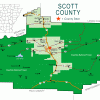
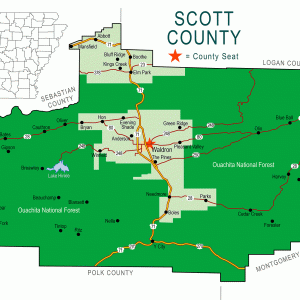
Scott County is located on the west-central boundary of Arkansas in the Ouachita Mountain region of the state. The topography of the area is mountainous and interspersed with expansive valleys along the Fourche LaFave, Petit Jean, and Poteau rivers and associated tributaries. The community of Waldron and portions of Mansfield are the two primary municipalities within Scott County. Major communities in Scott County are Abbott, Bates, Blue Ball, Boles, Cauthron, Cedar Creek, Harvey, Hon, Needmore, Nola, Parks, Union Hill, Winfield, and Y City.
Pre-European Exploration
Although little is known of those living in the area prior to 1,000 years ago, the first inhabitants of the Scott County area arrived millennia prior to any European exploration of the area. Over 2,500 archaeological sites, both pre-historic and historic, are known in the county, including sites from the Archaic Era, Woodland Era, and Mississippian Era.
The last 1,000 years show a strong Caddo presence, with settlements established along the banks of the various waterways. These waterways also served as major routes for travelers including Native Americans as well as European and American explorers and settlers.
Louisiana Purchase through Early Statehood
There is not sufficient evidence to conclude that any of the early European expeditions into Arkansas ever led to the area now known as Scott County. Some people traveled from the Red to the Arkansas Rivers via the Kiamachi River valley, then likely down the Poteau. Bernard de la Harpe came near Scott County on this route in the early 1700s, and Washington Irving also followed this general route. Thomas Nuttall led the first documented expedition to approach the area in 1819. In 1820, a party from the expedition of Major Stephen H. Long is also thought to have proceeded through the area.
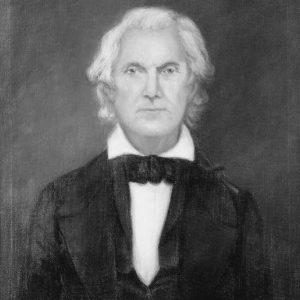
The county name was selected to honor territorial Superior Court Justice Andrew Scott. The Act of the Territorial General Assembly that created the county provided that the residence of Walter Cauthron, located near what is now Booneville (Logan County), would serve as the “temporary seat of Justice.” In 1836, faced with choosing a county seat of a more permanent nature, commissioners chose the community of Cauthron and proceeded to establish a courthouse. Because of numerous redefinitions of Scott County’s boundaries, this site of Cauthron is now within present-day Logan County and is not the present-day Scott County community known as Cauthron.
In 1840, popular opinion demanded that the county seat be in a more central location, and the community of Winfield, located one and a half to two miles northeast of present-day Waldron, was selected. This Winfield should not be confused with the present-day community with the same name.
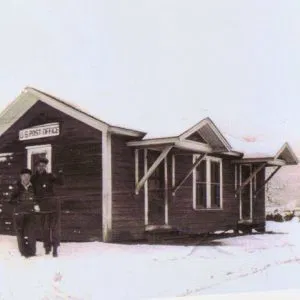
By the 1830s, William G. Featherston had settled near the site of present-day Waldron and established himself as a business owner, real estate developer, and postmaster of the area that is now Waldron. The post office was established under the name of Poteau Valley (or Poton Valley) on June 11, 1838. In 1845, Featherston offered ten acres of his land for a town to serve as the county seat. His offer of land was accepted, and owing in no small part to the poor road system to and from Winfield, the county was moved to what is now known as Waldron. The land was later surveyed and a plat designed by John P. Waldron, for whom Waldron is named.
Following the establishment of Waldron as the county seat, several years of relative prosperity, progress, and calm followed with the development of a merchant presence, hotels, and facilities of county government.
A lynching reportedly took place in 1843 in the county, although the details on the incident are sparse. An unnamed African American and a Native American known only as Joe were killed after being accused of murder. Joe was hanged, while the African American was burned to death.
Civil War through Reconstruction
As with some counties situated in mountainous regions, slavery, while it did exist, was not widespread in Scott County, and consequently, people were initially divided on the issue of secession. The 1860 federal census counted 4,930 white citizens in the county with 215 enslaved people. After the Civil War began, however, the county was overwhelmingly supportive of the Confederacy.
When the northwest corner of Arkansas fell to Union forces, Waldron was occupied by Union troops from October 1863 to late March of the following year. Most of the force was from the Second Kansas Cavalry, but troops from Indiana, Kansas, Missouri, Wisconsin, and some from Arkansas assisted in the occupation. Union scouting parties ventured out from Waldron, and although no major Civil War battles were fought in Scott County, several hostile encounters did take place. These engagements include multiple attacks on Waldron and a skirmish at Hahn’s Farm. Rations were in short supply, and the resources of Waldron were depleted during the occupation. Excepting the homes of Union sympathizers, much of the town was burned by Union troops upon departure.
The era of Reconstruction proceeded with economic stress, electoral controversy, and occasional flashes of violence. The confluence of these elements led to a series of violent events that came to be known as “the Waldron War.” These events, between the years 1874 and 1879, usually involved personal, political, or Civil War–related animus. The result was about thirty violent deaths and the militia being dispatched by the governor to the county on at least three occasions.
Post-Reconstruction through Early Twentieth Century
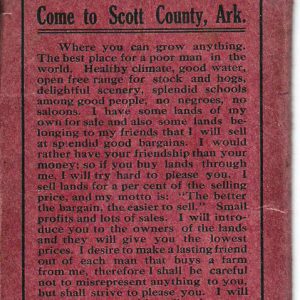
As Reconstruction ended, a period of relative quiet and tranquility began. The turn of the century brought railroads, a short-lived coal mining industry, sustained cotton crops, and a successful merchant district in downtown Waldron. The Arkansas Western Railroad linked Waldron with Heavener, Oklahoma, with regular passenger service beginning in 1904.
In spite of difficulties and hardships, growth was sustained, if modest, even in the turbulent times of World War I and the stock market catastrophe. The local economy was buffered somewhat by the railroads, coal, cotton, and the timber industry and was aided by the Depression-era relief measures, particularly the Works Progress Administration (WPA) and the Civilian Conservation Corps (CCC). The Poteau Work Center near Waldron and Cold Springs School in northeastern Scott County was constructed by the 1707th Company of the CCC and is listed on the National Register of Historic Places. The company also constructed a powder magazine.
World War II through the Modern Era
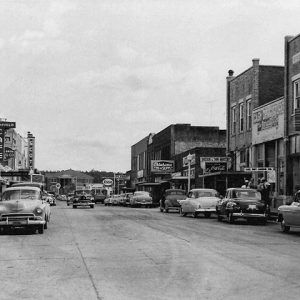
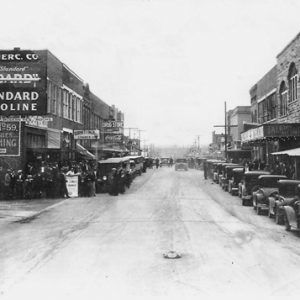
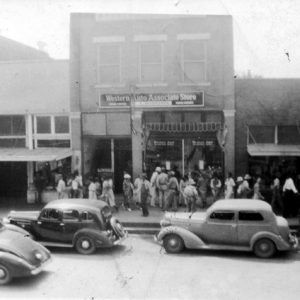
The post–World War II era brought trends toward manufacturing jobs, primarily the crafting of furniture, milling of lumber, and poultry production, while maintaining a solid merchant district along Main Street in Waldron.
The largest employer in the county is the poultry industry, represented by a Tyson Foods production plant that engages the county in all phases of poultry production. Yet another significant presence is O.K. Foods, which employs a number of people in the growing of chickens used at production plants elsewhere.
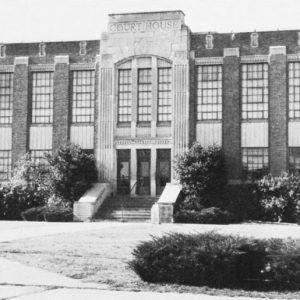
With the coming of larger chain establishments, the commercial district of Waldron shifted from Main Street to areas along the nearby Highway 71 bypass. With the installation of street lamps, a conservation easement, and renovations to the historic former courthouse, efforts have been made to renovate and revitalize the downtown area.
The most popular cultural attraction is the annual Turkey Track Bluegrass Festival that brings thousands of people from throughout the United States to Scott County. Blythe’s Museum was another local attraction that featured numerous artifacts of Native American villages that were once on the banks of area rivers, as well as other artifacts documenting the history of west-central Arkansas; Gary Blythe, owner of the collection, donated his materials, shortly before his passing in 2021, to what is now the Scott County Museum of History, which opened in 2022 in the old courthouse.
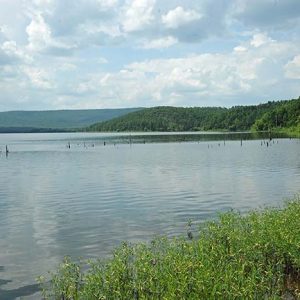
The most significant local natural attraction is the Ouachita National Forest. Also providing recreational opportunities is Lake Hinkle, a 960-acre lake constructed by the Arkansas Game and Fish Commission. The current courthouse was built in 1996 and is the seventh of its name.
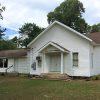
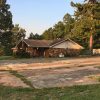
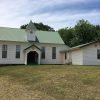
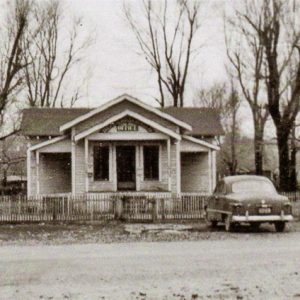
Historic sites in the county include the Parks School House, the Bates School House, the C. E. Forrester House, the Old Scott County Jail, the Waldron School Historic District, and Mount Pleasant Methodist Church. These sites are listed on the National Register of Historic Places.
The Scott-Sebastian Regional Library System, headquartered in Greenwood (Sebastian County), provides public library service to five branches in two counties.
For additional information:
Biographical and Historical Memoirs of Western Arkansas. Chicago: Goodspeed Publishing Company, 1891.
Cate, Michael. History of Scott County, Arkansas. Dallas: Curtis Media Corporation, 1991.
Echoes: The Scott County Historical and Genealogical Society Quarterly. Waldron, AR: Scott County Historical and Genealogical Society (1986–).
Goodner, Charles. Scott County in Retrospect. Mansfield, AR: Frank Boyd, 1976.
Goodner, Norman. A History of Scott County, Arkansas. Siloam Springs, AR: Bar D Press, 1941.
McCutcheon, Henry Grady. History of Scott County, Arkansas. Little Rock: H. G. Pugh and Company, 1922.
Scott County. http://scottcountyar.com/ (accessed February 2, 2026).
Smith, Alden O. Scott County, Arkansas: Gateway to the West. Tulsa, OK: The Printing Company, 1992.
Wes Goodner
Little Rock, Arkansas
Revised 2022, David Sesser, Southeastern Louisiana University


Comments
No comments on this entry yet.