 Music and Musicians
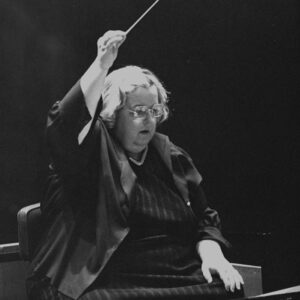 Sarah Caldwell
501-918-3025
calsfoundation@cals.org
calsfoundation@cals.org
A member of the Arkansas Entertainers Hall of Fame, Sarah Caldwell was an internationally recognized American opera director, conductor, producer, and impresario. She was known for emphasizing the dramatic elements of opera in her productions with innovative stagings that often included spectacular visual effects. She also was known for performing and staging obscure operas that were performed only rarely because of their difficulty.
Sarah Caldwell was born on March 6, 1924, in Maryville, Missouri, but grew up in Fayetteville (Washington County). Her parents divorced when she was young, and her mother—piano teacher Margaret Carrie Caldwell Baker—later married Henry Alexander, who taught political science at the University of Arkansas (UA) in Fayetteville.
Recognized as a child prodigy, she was performing in public on violin by the age of ten and graduated from Fayetteville High School at fourteen. Caldwell went on to study psychology at UA but left after a year and a half. She studied violin at Hendrix College in Conway (Faulkner County) and won a scholarship to the New England Conservatory of Music. In 1946, she won a scholarship in viola at the Berkshire Music Center in Tanglewood, Massachusetts. In 1947, she staged Ralph Vaughan Williams’s Riders to the Sea at Tanglewood. She served for eleven years as opera teacher Boris Goldovsky’s chief assistant.
Caldwell moved to Boston to head the Boston University opera workshop in 1952. In 1957, she started the Opera Company of Boston with $5,000. There, she staged a variety of operas, establishing a reputation for producing difficult works under pressure. In 1975, Caldwell was featured on the cover of Time magazine. Caldwell became the first female conductor of the Metropolitan Opera the following year. She appeared with the New York Philharmonic Orchestra, the Pittsburgh Symphony Orchestra, and the Boston Symphony Orchestra. In 1978, she was the first recipient of the Kennedy Center Award for Excellence. She became artistic director of the New Opera Company of Israel in 1983. In 1996, she traveled to the White House, where President Bill Clinton and First Lady Hillary Clinton presented her with the National Medal of Arts.
Known for taking on interesting and difficult works, Caldwell said that she wanted “to perform music which is wonderful that for some odd reason we have not yet explored.” Caldwell staged more than seventy-five operas, including such American premieres as Hector Berlioz’s Les Troyens (1972), Sergei Prokofiev’s War and Peace (1974), Roger Sessions’s Montezuma (1972), Mikhail Glinka’s Ruslan and Lyudmila (1977), Bernd Alois Zimmermann’s Die Soldaten (1982), Peter Maxwell Davies’s Taverner (1986), and Robert DiDomenica’s The Balcony (1990).
Her opera company closed in 1991, over $5 million in debt. She took many guest teaching and guest-conducting jobs after this, including a brief stint as distinguished professor of music at UA starting in 1999, but seldom worked in the United States.
Caldwell died on March 23, 2006, in Portland, Maine, at the age of eighty-two.
For additional information:
Duffie, Bruce. “Conversation Piece: Conductor Sarah Caldwell.” http://www.bruceduffie.com/caldwell.html (accessed February 27, 2024).
Kessler, Daniel. Sarah Caldwell: The First Woman of Opera. Lanham, MD: Scarecrow Press, 2008.
“Music’s Wonder Woman.” Time, November 10, 1975, pp. 52–54, 59, 65.
Schudel, Matt. “Opera Conductor and Impresario Sarah Caldwell, 82.” Washington Post, March 25, 2006, p. 6B. Online at http://www.washingtonpost.com/wp-dyn/content/article/2006/03/24/AR2006032401987.html (accessed February 27, 2024).
C. L. Bledsoe
Ghoti magazine





I enjoyed your writeup on Sarah Caldwell. I was artist-in-residence and principal tenor of her Opera Company of Boston from 1981 until it folded in 1990, singing lead roles in more than 100 opera performances during that time. I was liaison officer when Sarah and Madame Imelda Romualdez Marcos formed the Opera Company of the Philippines, singing the lead tenor role of Tamino in Mozart’s The Magic Flute in 1983. I also joined her for five years singing with the Ural State Philharmonic where she was principal guest conductor. I organized her memorial service on May 27, 2006, at Trinity Church, Copley Place, Boston, conducting the choir and orchestra of former members of OCB, and singing several solos and ensembles. It was an honor and a privilege to have been a part of Sarah’s life in music-making. I will always remember her fondly.